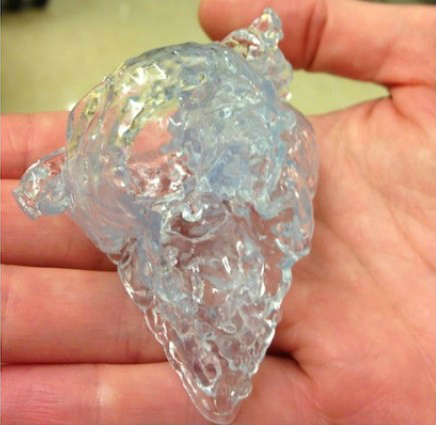
3D Printed Heart Saves Newborn Baby’s Life
In this uplifting story surgeon’s in New York used an astounding medical innovation that allowed them to plan a 2 week-old baby’s complicated heart surgery.
The baby was born at Morgan Stanley Children’s Hospital with CHD (congenital heart defects), which, while being the most common form of birth defect, can easily life-threatening if left untreated. Operating surgeon Dr Emile Bacha said “the baby’s heart had holes, which are not uncommon with CHD, but the heart chambers were also in an unusual formation, rather like a maze”. Any operation can be dangerous, but heart surgery on newborn infants is always high-risk and high-stress.
To help minimise risk the surgeons used an MRI scanner to create a 3D model of the baby’s unconventionally structured heart. The scan mapped the entire organ, inside and out, including all of the blood vessels and their anomalies. They then commissioned 3D printing company Replica 3DM to create an exact replica of the organ, which was funded by the Matthew’s Hearts of Hope foundation (check them out).
Using this tiny model, about ⅓ of the size of the surgeon’s hand (aww), they were able to plan the incredibly complex surgical procedure without having to perform multiple operations. “In the past we had to stop the heart and look inside to decide what to do,” Dr Bacha said. “With this technique, it was like we had a road map to guide us”.
The old practice involves stopping the patient’s heart in order to examine it, which can be very problematic in young children who cannot be deprived of oxygen for long. The 3D printed model allows surgeons create a roadmap before they cut the patient open, allowing them to get in and out as with the least internal faff as possible.
At least 8/1000 children are born with CHD every year, and hopefully with proper funding this groundbreaking technique could save hundreds of lives and hours under the hot operating room lights.
This is not the only way 3D printing has been taken to heart recently. Richard Arm at Nottingham Trent University developed a prosthetic human heart that is “as close as you can get” to the real thing, which could be a “real benefit” to trainee surgeons. In a radical claim Stuart K Williams from the Cardiovascular Innovation Institute at the University of Louisville predicts a fully 3D printed heart within the next 10 years if he can help it, saying: “Dare I say the heart is one of the easiest to bioprint? It’s just a pump with tubes you need to connect…”.
To find out more on how 3D printing could affect your life and to get involved in one of world’s most creative communities check out MakerClub.org and sign up to find out about our IndieGoGo campaign launching later this October.
Share with your friends



Leave a Reply